Author: s5y3t

  • How Industrial IoT Is Transforming Manufacturing Operations

    How Industrial IoT Is Transforming Manufacturing Operations

    Image

    Table of Contents

    1. Introduction
    2. Understanding Industrial IoT
    3. The Evolution of Connected Manufacturing
    4. Core Components of Industrial IoT
    5. How Industrial IoT Works in Manufacturing
    6. Real-Time Machine Monitoring
    7. Predictive Maintenance and Equipment Reliability
    8. Production Optimization Through Data Analytics
    9. Energy Management and Sustainability
    10. Quality Control Improvements
    11. Supply Chain Visibility and Inventory Management
    12. Worker Safety and Smart Monitoring
    13. Challenges of Industrial IoT Adoption
    14. Real Manufacturing Case Review
    15. Future Trends in Industrial IoT
    16. Best Practices for Successful IIoT Implementation
    17. Conclusion
    18. Frequently Asked Questions (FAQ)

    Introduction

    Manufacturing has always relied on innovation to improve efficiency, productivity, and competitiveness. From steam-powered machinery during the Industrial Revolution to computer-controlled production systems in the digital age, technological advancements have continuously reshaped factory operations.

    Today, another major transformation is underway. The Industrial Internet of Things (IIoT) is changing how manufacturers monitor equipment, manage production, reduce downtime, and make business decisions.

    Unlike traditional manufacturing systems that operate in isolation, Industrial IoT creates a connected environment where machines, sensors, software platforms, and employees communicate through data networks. This connectivity provides unprecedented visibility into factory operations and enables real-time decision-making that was impossible just a decade ago.

    Industrial IoT is not simply about connecting machines to the internet. It is about transforming raw operational data into valuable insights that help manufacturers increase productivity, improve product quality, enhance safety, and reduce costs.

    Across industries such as automotive, electronics, food processing, pharmaceuticals, packaging, and heavy manufacturing, companies are adopting Industrial IoT technologies to remain competitive in a rapidly evolving market.

    This article explores how Industrial IoT is transforming manufacturing operations, the technologies behind it, practical applications, benefits, challenges, and what the future may hold for connected factories.


    Understanding Industrial IoT

    Industrial IoT refers to the application of Internet of Things technologies within industrial environments.

    In simple terms, Industrial IoT connects:

    • Machines
    • Sensors
    • Production equipment
    • Software systems
    • Operators
    • Maintenance teams

    These connected devices continuously collect and exchange information.

    The data generated helps organizations monitor performance, identify issues, predict failures, and optimize production processes.

    Unlike consumer IoT devices such as smart speakers or home security systems, Industrial IoT focuses on improving industrial operations and business outcomes.

    Common Industrial IoT applications include:

    • Machine condition monitoring
    • Predictive maintenance
    • Energy management
    • Production analytics
    • Asset tracking
    • Quality control
    • Safety monitoring

    Industrial IoT forms one of the foundational technologies behind Industry 4.0.


    The Evolution of Connected Manufacturing

    Manufacturing technology has progressed through several major stages.

    Traditional Manufacturing

    In conventional factories, machines operated independently.

    Operators manually inspected equipment and recorded production information on paper.

    Decision-making often relied on experience rather than real-time data.

    Computerized Manufacturing

    The introduction of programmable controllers and industrial software improved automation capabilities.

    However, many systems remained isolated.

    Information was stored within individual machines or departments.

    Networked Manufacturing

    As networking technologies improved, manufacturers began connecting production systems.

    Data sharing became easier, allowing better coordination between departments.

    Industrial IoT Era

    Today’s connected factories leverage sensors, cloud computing, advanced analytics, and artificial intelligence.

    Machines communicate continuously, generating valuable operational insights.

    This shift enables proactive rather than reactive management strategies.


    Core Components of Industrial IoT

    Several technologies work together to create Industrial IoT environments.

    Smart Sensors

    Sensors collect data from equipment and processes.

    Common measurements include:

    • Temperature
    • Pressure
    • Vibration
    • Humidity
    • Energy consumption
    • Flow rates

    Connectivity Infrastructure

    Data must travel between devices and software systems.

    Common communication technologies include:

    • Ethernet
    • Wi-Fi
    • 5G
    • Industrial protocols
    • Wireless sensor networks

    Edge Computing

    Edge devices process data near the source.

    This reduces latency and allows faster responses to operational events.

    Cloud Platforms

    Cloud systems store and analyze large amounts of industrial data.

    They provide centralized visibility across multiple facilities.

    Analytics Software

    Advanced analytics transforms raw information into actionable insights.


    How Industrial IoT Works in Manufacturing

    Industrial IoT systems follow a straightforward process.

    Step 1: Data Collection

    Sensors continuously gather operational information.

    Step 2: Data Transmission

    Collected data is transmitted through industrial networks.

    Step 3: Data Processing

    Software platforms analyze incoming information.

    Step 4: Decision Support

    Insights are presented to operators and managers.

    Step 5: Automated Response

    In some systems, machines automatically adjust operating parameters based on analytics results.

    This cycle repeats continuously, creating a highly responsive production environment.


    Real-Time Machine Monitoring

    One of the most valuable Industrial IoT applications involves real-time machine monitoring.

    Historically, operators often discovered equipment problems only after production performance declined.

    Industrial IoT changes this approach.

    Connected machines continuously report:

    • Operating status
    • Production rates
    • Temperature conditions
    • Energy usage
    • Equipment health indicators

    Managers gain immediate visibility into production operations.

    Benefits include:

    • Faster problem detection
    • Improved operational transparency
    • Reduced downtime
    • Better resource allocation

    Real-time monitoring also supports more informed decision-making across the organization.


    Predictive Maintenance and Equipment Reliability

    Maintenance remains one of the largest operational expenses in manufacturing.

    Traditional maintenance approaches often fall into two categories:

    Reactive Maintenance

    Repairs occur after equipment failures.

    Preventive Maintenance

    Maintenance follows fixed schedules regardless of actual equipment condition.

    Industrial IoT enables a third approach.

    Predictive Maintenance

    Connected sensors monitor machine health continuously.

    Examples include:

    • Vibration analysis
    • Temperature monitoring
    • Oil condition analysis
    • Motor current monitoring

    When abnormal patterns appear, maintenance teams receive alerts.

    This allows repairs before failures occur.

    Benefits include:

    • Reduced downtime
    • Lower maintenance costs
    • Extended equipment lifespan
    • Improved reliability

    Predictive maintenance has become one of the strongest business cases for Industrial IoT investments.


    Production Optimization Through Data Analytics

    Manufacturing operations generate enormous volumes of data every day.

    Without Industrial IoT, much of this information remains unused.

    Data analytics helps manufacturers identify:

    • Bottlenecks
    • Inefficient processes
    • Performance variations
    • Quality issues

    For example:

    A production line may consistently slow down during specific shifts.

    Analytics can uncover root causes such as:

    • Operator practices
    • Material inconsistencies
    • Equipment performance variations

    These insights support continuous improvement initiatives.

    Manufacturers can optimize:

    • Cycle times
    • Resource utilization
    • Throughput
    • Scheduling

    As a result, overall productivity improves significantly.


    Energy Management and Sustainability

    Energy costs represent a major expense for many manufacturers.

    Industrial IoT enables detailed energy monitoring.

    Sensors track consumption across:

    • Machines
    • Production lines
    • Facilities
    • Utility systems

    Managers can identify:

    • Energy-intensive equipment
    • Wasteful operating practices
    • Peak demand periods

    By addressing inefficiencies, organizations reduce:

    • Operating costs
    • Carbon emissions
    • Environmental impact

    Sustainability initiatives increasingly rely on Industrial IoT data.


    Image

    Quality Control Improvements

    Quality remains a critical priority in manufacturing.

    Defective products create:

    • Rework costs
    • Waste
    • Customer complaints
    • Reputation damage

    Industrial IoT improves quality control through continuous monitoring.

    Sensors track process parameters in real time.

    Examples include:

    • Temperature
    • Pressure
    • Speed
    • Alignment
    • Environmental conditions

    When variables move outside acceptable limits, alerts are generated immediately.

    This enables faster corrective action.

    Some systems even make automatic adjustments to maintain product quality.

    Image

    Supply Chain Visibility and Inventory Management

    Industrial IoT extends beyond factory floors.

    Connected technologies improve visibility throughout supply chains.

    Manufacturers can monitor:

    • Raw material inventory
    • Work-in-progress products
    • Finished goods
    • Transportation assets

    Real-time tracking reduces uncertainty and improves planning accuracy.

    Benefits include:

    • Reduced inventory costs
    • Improved delivery performance
    • Better demand forecasting
    • Lower risk of stock shortages

    Connected supply chains support more agile manufacturing operations.


    Worker Safety and Smart Monitoring

    Safety remains a top priority across industrial environments.

    Industrial IoT contributes to safer workplaces through smart monitoring solutions.

    Examples include:

    Wearable Safety Devices

    Workers can wear connected devices that monitor:

    • Location
    • Fatigue levels
    • Environmental exposure

    Hazard Detection Systems

    Sensors identify dangerous conditions such as:

    • Gas leaks
    • Excessive temperatures
    • Equipment malfunctions

    Emergency Response Support

    Connected systems provide real-time alerts during incidents.

    These technologies help organizations reduce workplace risks while improving operational awareness.


    Challenges of Industrial IoT Adoption

    Despite its benefits, Industrial IoT implementation presents several challenges.

    Cybersecurity Risks

    Connected systems increase exposure to cyber threats.

    Manufacturers must protect:

    • Networks
    • Data
    • Production systems

    Strong cybersecurity strategies are essential.

    Integration Complexity

    Many factories operate legacy equipment.

    Connecting older systems can be technically challenging.

    Data Overload

    Industrial IoT generates enormous amounts of information.

    Organizations need effective analytics tools to extract meaningful insights.

    Investment Requirements

    Initial implementation costs may include:

    • Sensors
    • Software
    • Infrastructure upgrades
    • Employee training

    Successful projects require careful planning and execution.


    Real Manufacturing Case Review

    Packaging Manufacturing Company

    A packaging manufacturer experienced recurring equipment failures and rising maintenance costs.

    Initial Situation

    Challenges included:

    • Frequent production interruptions
    • Limited machine visibility
    • Reactive maintenance practices

    Management lacked reliable data for decision-making.

    Industrial IoT Implementation

    The company installed:

    • Vibration sensors
    • Energy monitoring devices
    • Production tracking software
    • Cloud-based analytics platforms

    Results After Twelve Months

    The facility achieved:

    • 35% reduction in unplanned downtime
    • 22% lower maintenance costs
    • 18% improvement in production output
    • Significant improvement in equipment reliability

    Key Lesson

    The project demonstrated that operational visibility often creates substantial productivity gains without requiring major equipment replacement.


    Future Trends in Industrial IoT

    Industrial IoT continues to evolve rapidly.

    Artificial Intelligence Integration

    AI systems will increasingly automate decision-making.

    Digital Twins

    Virtual models of equipment and production systems will support simulation and optimization.

    Edge Intelligence

    More analytics will occur directly at machine level.

    5G Connectivity

    Faster wireless communication will improve responsiveness and scalability.

    Autonomous Operations

    Factories will move toward self-optimizing production environments.

    These innovations will further expand the capabilities of connected manufacturing systems.


    Best Practices for Successful IIoT Implementation

    Manufacturers should follow several best practices.

    Start with Clear Objectives

    Define measurable goals before implementation.

    Focus on High-Value Applications

    Prioritize areas such as:

    • Predictive maintenance
    • Energy monitoring
    • Production optimization

    Ensure Cybersecurity Readiness

    Protect connected systems from emerging threats.

    Invest in Workforce Training

    Employees must understand new technologies and workflows.

    Build Scalable Infrastructure

    Choose solutions that support future expansion.

    Continuously Measure Results

    Monitor performance indicators to evaluate project success.


    Conclusion

    Industrial IoT is fundamentally transforming manufacturing operations by connecting machines, people, and systems through real-time data. This connectivity enables unprecedented visibility into production processes, helping organizations improve productivity, reduce downtime, enhance quality, strengthen safety, and lower operational costs.

    From predictive maintenance and energy management to supply chain visibility and advanced analytics, Industrial IoT provides manufacturers with powerful tools for continuous improvement. While implementation challenges exist, the long-term benefits often outweigh the initial investment.

    As technologies such as artificial intelligence, digital twins, edge computing, and 5G continue to mature, Industrial IoT will play an increasingly important role in shaping the factories of the future. Manufacturers that embrace connected operations today will be better positioned to compete in tomorrow’s highly digital industrial landscape.


    Frequently Asked Questions (FAQ)

    What is Industrial IoT?

    Industrial IoT (IIoT) refers to connected industrial devices, sensors, machines, and software systems that collect and exchange operational data to improve manufacturing performance.

    How does Industrial IoT improve manufacturing productivity?

    IIoT provides real-time visibility into production processes, enabling faster decision-making, predictive maintenance, and operational optimization.

    What is predictive maintenance?

    Predictive maintenance uses sensor data and analytics to identify equipment issues before failures occur, reducing downtime and repair costs.

    How does Industrial IoT support quality control?

    Connected sensors continuously monitor production parameters and detect abnormalities that could affect product quality.

    Is Industrial IoT expensive to implement?

    Costs vary depending on project scope, but many manufacturers achieve strong returns through reduced downtime, lower maintenance expenses, and improved productivity.

    What industries benefit from Industrial IoT?

    Industries such as automotive, electronics, pharmaceuticals, food processing, packaging, logistics, mining, and energy commonly use IIoT technologies.

    What are the biggest challenges of Industrial IoT adoption?

    Key challenges include cybersecurity, integration with legacy equipment, data management, and workforce training.

    What is the future of Industrial IoT?

    Future developments include AI-powered analytics, digital twins, autonomous operations, edge intelligence, and highly connected smart factories.
  • How Industrial Automation Is Reshaping Modern Manufacturing

    How Industrial Automation Is Reshaping Modern Manufacturing

    Image

    Table of Contents

    1. Introduction
    2. What Is Industrial Automation?
    3. The Evolution of Manufacturing Automation
    4. Why Manufacturers Are Investing in Automation
    5. Types of Industrial Automation Systems
    6. Robotics and Automated Production Lines
    7. The Role of Artificial Intelligence in Manufacturing
    8. Industrial IoT and Connected Factories
    9. Benefits of Industrial Automation
    10. Challenges and Risks of Automation Adoption
    11. Impact on Workforce and Employment
    12. Real Manufacturing Case Review
    13. Future Trends in Industrial Automation
    14. Best Practices for Successful Automation Projects
    15. Conclusion
    16. Frequently Asked Questions (FAQ)

    Introduction

    Manufacturing has undergone remarkable transformations throughout history. From manual labor and steam-powered machinery during the Industrial Revolution to highly sophisticated digital factories today, every technological leap has redefined how products are designed, produced, and delivered.

    Among the most significant developments in recent decades is industrial automation. What was once considered an expensive luxury reserved for large corporations has become a critical component of modern manufacturing operations. Today, manufacturers of all sizes are integrating automation technologies to improve efficiency, increase productivity, reduce costs, and remain competitive in a rapidly evolving market.

    Industrial automation is no longer limited to robotic arms welding car bodies on automotive assembly lines. It now extends to smart sensors, artificial intelligence, machine vision systems, predictive maintenance platforms, and interconnected production networks capable of making data-driven decisions in real time.

    As global competition intensifies and customer expectations continue to rise, manufacturers are under increasing pressure to deliver higher-quality products faster and more efficiently. Automation has emerged as one of the most powerful solutions to these challenges.

    This article explores how industrial automation is reshaping modern manufacturing, the technologies driving this transformation, the benefits and challenges involved, and what the future may hold for smart factories around the world.


    What Is Industrial Automation?

    Industrial automation refers to the use of technology, control systems, software, and machinery to perform manufacturing tasks with minimal human intervention.

    The primary goal of automation is to increase efficiency while maintaining consistency, accuracy, and safety.

    Automation systems can control various manufacturing processes, including:

    • Assembly operations
    • Material handling
    • Packaging
    • Inspection
    • Quality control
    • Machine operation
    • Inventory management

    Unlike traditional manufacturing methods that depend heavily on manual labor, automated systems perform repetitive tasks with precision and reliability.

    Automation technologies often include:

    • Programmable Logic Controllers (PLCs)
    • Human Machine Interfaces (HMIs)
    • Sensors
    • Robotics
    • Industrial IoT devices
    • Artificial Intelligence systems
    • Supervisory Control and Data Acquisition (SCADA) platforms

    Together, these technologies create highly efficient production environments capable of operating around the clock.


    The Evolution of Manufacturing Automation

    Automation has evolved significantly over the past century.

    Early Mechanization

    During the early stages of industrialization, machines primarily assisted human workers by reducing physical labor.

    Examples included:

    • Steam-powered equipment
    • Mechanical looms
    • Conveyor systems

    Although productivity improved, human operators remained responsible for most decisions and machine adjustments.

    Fixed Automation Era

    As manufacturing demand increased, factories introduced specialized equipment designed to perform specific tasks repeatedly.

    Examples included:

    • Automated bottling lines
    • Stamping machines
    • Conveyor-based assembly systems

    These systems offered high production rates but lacked flexibility.

    Programmable Automation

    The introduction of computers transformed manufacturing.

    Programmable systems enabled manufacturers to modify production processes without replacing entire machines.

    Technologies such as CNC machines revolutionized industries by allowing automated precision machining.

    Smart Manufacturing

    Today’s factories represent the next stage of evolution.

    Smart manufacturing combines automation with:

    • Data analytics
    • Cloud computing
    • AI
    • Industrial IoT
    • Machine learning

    Modern equipment can communicate, monitor itself, and support predictive decision-making.


    Why Manufacturers Are Investing in Automation

    Several factors are accelerating automation adoption worldwide.

    Increasing Labor Costs

    Many industries face rising labor expenses.

    Automation helps manufacturers maintain profitability by reducing reliance on repetitive manual tasks.

    Demand for Higher Productivity

    Customers expect faster delivery times and consistent product quality.

    Automated systems can operate continuously with minimal downtime.

    Product Quality Requirements

    Automation reduces human error and ensures repeatable processes.

    This consistency is particularly important in industries such as:

    • Automotive manufacturing
    • Pharmaceuticals
    • Electronics
    • Food processing

    Labor Shortages

    Many regions face difficulties finding skilled manufacturing workers.

    Automation helps address workforce gaps while maintaining production capacity.

    Competitive Pressure

    Manufacturers that fail to modernize risk losing market share to competitors using more efficient production methods.


    Types of Industrial Automation Systems

    Industrial automation can be categorized into several major types.

    Fixed Automation

    Designed for high-volume production of identical products.

    Characteristics:

    • High speed
    • Low flexibility
    • Significant initial investment

    Examples:

    • Automotive assembly lines
    • Beverage bottling systems

    Programmable Automation

    Suitable for batch production.

    Machines can be reprogrammed to manufacture different products.

    Examples:

    • CNC machining centers
    • Automated welding systems

    Flexible Automation

    Allows rapid switching between products with minimal downtime.

    Common in industries requiring product customization.

    Examples:

    • Flexible manufacturing systems
    • Robotic production cells

    Integrated Automation

    Combines multiple automation technologies into a unified production environment.

    Examples include smart factories where machines, sensors, and software communicate seamlessly.


    Robotics and Automated Production Lines

    Industrial robots have become symbols of manufacturing automation.

    Modern robots perform tasks such as:

    • Welding
    • Painting
    • Assembly
    • Packaging
    • Material transport
    • Quality inspection

    Advantages of robotics include:

    Precision

    Robots consistently perform tasks with exceptional accuracy.

    Speed

    Automated systems often complete tasks faster than human workers.

    Reliability

    Robots maintain performance over extended operating periods.

    Safety

    Dangerous or hazardous operations can be assigned to robotic systems.

    Collaborative robots, often called cobots, represent a growing trend.

    Unlike traditional industrial robots, cobots are designed to work safely alongside human employees.


    The Role of Artificial Intelligence in Manufacturing

    Artificial Intelligence has become one of the most transformative technologies in industrial automation.

    AI enables machines to:

    • Analyze production data
    • Detect anomalies
    • Predict failures
    • Optimize processes
    • Improve quality control

    Predictive Maintenance

    AI can identify early signs of equipment deterioration.

    By analyzing sensor data, algorithms detect patterns associated with future failures.

    Benefits include:

    • Reduced downtime
    • Lower maintenance costs
    • Improved equipment reliability

    Automated Quality Inspection

    AI-powered vision systems can inspect products faster and more accurately than manual inspection methods.

    These systems detect:

    • Surface defects
    • Dimensional inaccuracies
    • Assembly errors

    Process Optimization

    Machine learning algorithms continuously analyze production data to identify efficiency improvements.


    Industrial IoT and Connected Factories

    The Industrial Internet of Things (IIoT) connects machines, sensors, and systems through digital networks.

    IIoT enables real-time visibility across manufacturing operations.

    Common IIoT applications include:

    • Machine monitoring
    • Energy management
    • Inventory tracking
    • Predictive maintenance
    • Production analytics

    Smart sensors continuously collect data such as:

    • Temperature
    • Pressure
    • Vibration
    • Humidity
    • Energy consumption

    This information supports faster and more informed decision-making.


    Image
    Image

    Benefits of Industrial Automation

    Industrial automation offers numerous advantages.

    Increased Productivity

    Automated systems operate continuously with minimal interruptions.

    Many factories achieve significant output increases after implementing automation technologies.

    Improved Product Quality

    Automation ensures process consistency and reduces variability.

    This results in fewer defects and less rework.

    Reduced Operating Costs

    Although automation requires investment, long-term savings often include:

    • Lower labor costs
    • Reduced waste
    • Improved energy efficiency

    Enhanced Workplace Safety

    Automation reduces worker exposure to dangerous environments.

    Examples include:

    • High-temperature processes
    • Heavy lifting
    • Hazardous chemicals

    Better Data Visibility

    Managers gain access to real-time operational insights.

    This visibility supports faster problem resolution and strategic planning.


    Challenges and Risks of Automation Adoption

    Despite its advantages, automation also presents challenges.

    High Initial Investment

    Purchasing automation equipment often requires significant capital expenditure.

    Smaller manufacturers may find adoption difficult without careful planning.

    Integration Complexity

    New technologies must integrate with existing systems.

    Compatibility issues can delay implementation.

    Cybersecurity Concerns

    Connected factories face increasing cybersecurity risks.

    Manufacturers must protect systems from unauthorized access and cyberattacks.

    Skill Gaps

    Advanced automation requires personnel with specialized technical expertise.

    Training becomes essential for successful implementation.


    Impact on Workforce and Employment

    One of the most debated aspects of automation involves employment.

    Some fear automation will eliminate manufacturing jobs entirely.

    The reality is more nuanced.

    Automation often replaces repetitive tasks rather than entire occupations.

    Meanwhile, new roles emerge in areas such as:

    • Robotics maintenance
    • Data analytics
    • Automation engineering
    • AI system management
    • Industrial cybersecurity

    Employees increasingly transition from manual labor to higher-value technical responsibilities.

    Successful organizations invest heavily in workforce development to support this transition.


    Real Manufacturing Case Review

    Electronics Manufacturing Facility

    A mid-sized electronics manufacturer experienced rising labor costs and increasing product demand.

    Initial Challenges

    The company faced:

    • Manual assembly bottlenecks
    • Quality inconsistencies
    • Frequent production delays

    Production output struggled to keep pace with customer orders.

    Automation Strategy

    Management implemented:

    • Robotic assembly stations
    • Automated optical inspection systems
    • IoT-based machine monitoring
    • Production analytics software

    Results After One Year

    The facility achieved:

    • 38% increase in production capacity
    • 45% reduction in assembly errors
    • 30% decrease in quality-related rework
    • Significant improvement in on-time delivery performance

    Key Takeaway

    The project demonstrated that automation can enhance both productivity and quality when integrated strategically.


    Future Trends in Industrial Automation

    The future of manufacturing automation continues to evolve rapidly.

    Artificial Intelligence Expansion

    AI will increasingly support autonomous decision-making.

    Digital Twins

    Digital replicas of manufacturing systems will enable virtual testing and optimization.

    Edge Computing

    Real-time processing at the machine level will reduce latency and improve responsiveness.

    Autonomous Mobile Robots

    Factories will increasingly use mobile robots for material transport and logistics.

    Sustainable Manufacturing

    Automation will play a major role in reducing waste, energy consumption, and environmental impact.


    Best Practices for Successful Automation Projects

    Manufacturers considering automation should follow several key principles.

    Define Clear Objectives

    Identify measurable goals such as:

    • Increased output
    • Reduced downtime
    • Improved quality

    Start with High-Impact Areas

    Focus on processes with the greatest productivity improvement potential.

    Invest in Employee Training

    Workforce readiness significantly influences project success.

    Prioritize Data Collection

    Reliable data supports better decision-making and performance measurement.

    Plan for Scalability

    Automation systems should support future growth and technological expansion.

    Monitor Performance Continuously

    Regular evaluation ensures expected benefits are achieved.


    Conclusion

    Industrial automation is fundamentally reshaping modern manufacturing by transforming how products are designed, produced, monitored, and delivered. Through robotics, artificial intelligence, Industrial IoT, advanced analytics, and smart factory technologies, manufacturers can achieve unprecedented levels of productivity, quality, efficiency, and flexibility.

    While automation introduces challenges such as implementation costs, cybersecurity risks, and workforce adaptation, the long-term benefits often outweigh these obstacles. Organizations that strategically embrace automation position themselves to compete effectively in an increasingly digital and globalized marketplace.

    The factories of the future will not simply be automatedโ€”they will be intelligent, connected, adaptive, and capable of continuously optimizing themselves. Manufacturers that begin this journey today will be better prepared for tomorrow’s industrial landscape.


    Frequently Asked Questions (FAQ)

    What is industrial automation?

    Industrial automation is the use of technology, software, robotics, and control systems to perform manufacturing processes with minimal human intervention.

    Why is automation important in manufacturing?

    Automation improves productivity, quality, safety, consistency, and operational efficiency while reducing costs and downtime.

    What industries benefit most from automation?

    Industries such as automotive, electronics, pharmaceuticals, food processing, logistics, packaging, and aerospace benefit significantly from automation technologies.

    Does automation eliminate jobs?

    Automation primarily replaces repetitive tasks. It also creates new technical roles involving robotics, maintenance, programming, analytics, and system management.

    What is Industry 4.0?

    Industry 4.0 refers to the integration of digital technologies such as AI, Industrial IoT, cloud computing, and automation into manufacturing operations.

    What is predictive maintenance?

    Predictive maintenance uses sensors and analytics to detect potential equipment failures before they occur, reducing downtime and maintenance costs.

    How do smart factories work?

    Smart factories use connected machines, sensors, software, and data analytics to monitor, optimize, and automate manufacturing processes in real time.

    What is the future of industrial automation?

    Future developments include AI-driven decision-making, digital twins, autonomous robots, advanced analytics, edge computing, and more sustainable manufacturing systems.

  • Key Performance Factors That Influence Industrial Machine Productivity

    Key Performance Factors That Influence Industrial Machine Productivity

    Image
    Image

    Table of Contents

    1. Introduction
    2. Understanding Industrial Machine Productivity
    3. Machine Reliability and Equipment Condition
    4. Operator Skills and Workforce Competency
    5. Preventive and Predictive Maintenance
    6. Production Planning and Scheduling
    7. Machine Utilization Rate
    8. Quality of Raw Materials
    9. Automation and Smart Manufacturing
    10. Environmental Conditions Inside the Facility
    11. Energy Efficiency and Machine Performance
    12. Data Monitoring and Performance Analytics
    13. Downtime Management Strategies
    14. Safety Practices and Productivity
    15. Real Case Review from Manufacturing Operations
    16. Common Productivity Challenges
    17. Best Practices for Long-Term Productivity Improvement
    18. Conclusion
    19. Frequently Asked Questions (FAQ)
    Image

    Introduction

    Industrial machinery serves as the backbone of modern manufacturing operations. Whether producing automotive components, consumer electronics, food products, packaging materials, or industrial equipment, machine productivity directly influences operational profitability and competitiveness.

    Many manufacturing managers assume that purchasing advanced equipment automatically guarantees higher productivity. In reality, machine productivity depends on numerous interconnected factors, including maintenance quality, operator expertise, machine utilization, production planning, environmental conditions, and technological integration.

    A highly advanced machine can still perform poorly if maintenance schedules are neglected, operators lack sufficient training, or production planning is inefficient. Conversely, even older machinery can deliver impressive productivity when properly maintained and optimized.

    Image

    Understanding these key performance factors enables manufacturers to maximize output, reduce operational costs, improve product quality, and increase overall equipment effectiveness (OEE).


    Understanding Industrial Machine Productivity

    Industrial machine productivity refers to the amount of valuable output generated by equipment within a specific timeframe.

    Productivity is commonly measured through:

    • Production output per hour
    • Machine utilization percentage
    • Equipment efficiency
    • Downtime frequency
    • Product quality rates
    • Overall Equipment Effectiveness (OEE)

    A productive machine operates consistently, produces quality products, minimizes downtime, and consumes resources efficiently.

    Three major dimensions influence productivity:

    1. Availability
    2. Performance
    3. Quality
    Image

    When any one of these dimensions declines, overall productivity decreases.


    Machine Reliability and Equipment Condition

    One of the most critical factors influencing productivity is machine reliability.

    Machines that frequently experience breakdowns create significant disruptions throughout the production process.

    Common reliability issues include:

    • Worn bearings
    • Hydraulic leaks
    • Motor failures
    • Belt wear
    • Electrical faults
    • Sensor malfunctions

    Every unexpected breakdown creates:

    • Lost production time
    • Increased repair costs
    • Delayed deliveries
    • Reduced customer satisfaction

    Manufacturers often discover that a machine producing below expectations suffers from hidden mechanical degradation that has accumulated over months or years.

    Image

    Regular inspections help identify these issues before they develop into costly failures.


    Operator Skills and Workforce Competency

    Even the most sophisticated machinery still depends on skilled human operators.

    Well-trained operators can:

    • Detect abnormal machine behavior
    • Adjust settings correctly
    • Minimize setup times
    • Reduce production errors
    • Respond quickly to operational issues

    Poorly trained personnel often cause:

    • Excessive downtime
    • Product defects
    • Incorrect machine configurations
    • Accelerated equipment wear

    Training should cover:

    • Machine operation
    • Safety procedures
    • Troubleshooting techniques
    • Quality control standards
    • Maintenance awareness

    Continuous workforce development remains one of the highest-return investments in manufacturing environments.


    Preventive and Predictive Maintenance

    Maintenance directly affects machine productivity.

    Many factories still rely on reactive maintenance, where repairs occur only after failures happen.

    This approach often results in:

    • Unplanned downtime
    • Emergency repair costs
    • Production losses
    • Spare part shortages

    Preventive maintenance schedules inspections and servicing before failures occur.

    Typical preventive activities include:

    • Lubrication
    • Filter replacement
    • Alignment checks
    • Belt inspections
    • Electrical testing

    Predictive maintenance goes even further by using:

    • Vibration analysis
    • Thermal imaging
    • Oil analysis
    • Sensor monitoring
    • AI-based diagnostics

    Predictive strategies help maintenance teams identify problems long before breakdowns occur.


    Production Planning and Scheduling

    Productivity is not determined solely by machine performance.

    Poor production planning can severely reduce output even when machinery functions perfectly.

    Scheduling problems often include:

    • Frequent product changeovers
    • Material shortages
    • Idle machines
    • Excessive setup times

    Effective planning ensures:

    • Continuous workflow
    • Balanced workloads
    • Efficient resource allocation
    • Reduced bottlenecks

    Manufacturers that optimize production schedules often increase productivity without purchasing additional equipment.


    Machine Utilization Rate

    Machine utilization measures how effectively equipment is used during available operating hours.

    For example:

    • Machine available: 10 hours
    • Productive operation: 8 hours

    Utilization rate:

    80%

    Low utilization usually results from:

    • Operator shortages
    • Material delays
    • Long setup times
    • Maintenance interruptions

    Improving utilization frequently generates substantial productivity gains.

    However, utilization should be balanced carefully.

    Running machinery continuously without maintenance can increase wear and eventually reduce long-term productivity.


    Quality of Raw Materials

    Raw material consistency has a major impact on machine performance.

    Inferior materials often cause:

    • Machine jams
    • Product defects
    • Increased waste
    • Additional downtime

    For example:

    Packaging equipment may struggle with inconsistent film thickness.

    Injection molding machines may produce defective parts when resin quality varies.

    Metalworking machinery may experience accelerated tool wear due to poor-quality materials.

    Reliable suppliers contribute directly to production efficiency.


    Automation and Smart Manufacturing

    Modern automation technologies have transformed industrial productivity.

    Automation systems reduce dependence on manual processes and improve consistency.

    Examples include:

    • Robotic handling systems
    • Automated inspection stations
    • Conveyor automation
    • Vision systems
    • Automated packaging equipment

    Benefits include:

    • Faster production cycles
    • Reduced labor costs
    • Lower error rates
    • Improved consistency

    Smart manufacturing expands these benefits further through real-time monitoring and data analytics.


    Environmental Conditions Inside the Facility

    Factory conditions significantly influence machine productivity.

    Critical environmental factors include:

    Temperature

    Excessive heat can:

    • Damage electronics
    • Reduce motor efficiency
    • Accelerate component wear

    Humidity

    High humidity may cause:

    • Corrosion
    • Electrical failures
    • Sensor malfunctions

    Dust and Contamination

    Dust accumulation can lead to:

    • Cooling system blockage
    • Bearing damage
    • Reduced machine lifespan

    Maintaining proper environmental controls helps preserve machine performance.


    Energy Efficiency and Machine Performance

    Energy efficiency and productivity are closely related.

    Machines operating inefficiently often experience:

    • Excessive heat generation
    • Higher operating costs
    • Increased wear

    Common efficiency improvements include:

    • Variable frequency drives (VFDs)
    • High-efficiency motors
    • Energy monitoring systems
    • Optimized operating parameters

    Reducing energy waste often improves productivity simultaneously.


    Data Monitoring and Performance Analytics

    Modern factories increasingly rely on data-driven decision-making.

    Performance monitoring systems track:

    • Production rates
    • Downtime events
    • Energy consumption
    • Machine health
    • Quality metrics

    Real-time dashboards allow managers to identify issues immediately.

    Without performance data, productivity improvement becomes largely based on assumptions.

    Data analytics helps organizations:

    • Identify bottlenecks
    • Predict failures
    • Optimize workflows
    • Improve resource allocation

    Downtime Management Strategies

    Downtime remains one of the largest productivity killers in manufacturing.

    Downtime categories include:

    Planned Downtime

    Examples:

    • Maintenance
    • Equipment upgrades
    • Cleaning

    Unplanned Downtime

    Examples:

    • Equipment failures
    • Power outages
    • Material shortages

    The goal is not necessarily eliminating downtime but reducing unexpected downtime.

    Strategies include:

    • Root cause analysis
    • Spare parts management
    • Predictive maintenance
    • Operator training

    Safety Practices and Productivity

    Some organizations mistakenly view safety measures as productivity obstacles.

    In reality, strong safety programs improve productivity by reducing:

    • Workplace injuries
    • Equipment damage
    • Production interruptions

    Safe workplaces often experience:

    • Higher employee morale
    • Lower absenteeism
    • Greater operational stability

    A machine operating safely typically performs more consistently over time.


    Real Case Review from Manufacturing Operations

    Automotive Parts Manufacturer

    An automotive supplier experienced recurring downtime on its CNC machining line.

    Initial Situation

    Problems included:

    • Frequent spindle failures
    • Excessive downtime
    • Production delays

    Monthly productivity averaged:

    • 68% OEE

    Actions Taken

    The company implemented:

    • Predictive vibration monitoring
    • Operator retraining
    • Improved maintenance scheduling
    • Spare parts inventory optimization

    Results After Six Months

    Achievements included:

    • Downtime reduced by 42%
    • Maintenance costs reduced by 18%
    • OEE increased from 68% to 84%
    • Customer delivery performance improved significantly

    Key Lesson

    The biggest productivity gains came not from purchasing new machines but from optimizing existing equipment management practices.


    Common Productivity Challenges

    Manufacturers commonly encounter:

    Aging Equipment

    Older machines often require increased maintenance and may lack modern monitoring capabilities.

    Labor Shortages

    Finding experienced operators remains challenging in many regions.

    Rising Energy Costs

    Energy-intensive operations face increasing pressure to improve efficiency.

    Supply Chain Disruptions

    Material shortages can leave productive machines sitting idle.

    Rapid Technology Changes

    Keeping equipment and workforce skills current requires ongoing investment.


    Best Practices for Long-Term Productivity Improvement

    Organizations seeking sustainable productivity growth should focus on:

    Establishing Preventive Maintenance Programs

    Preventing failures is more cost-effective than repairing them.

    Investing in Operator Training

    Skilled operators consistently achieve better results.

    Monitoring Key Performance Indicators

    Track metrics such as:

    • OEE
    • Downtime
    • Scrap rates
    • Energy consumption

    Implementing Smart Sensors

    Real-time condition monitoring helps identify emerging problems.

    Conducting Root Cause Analysis

    Addressing symptoms alone rarely solves productivity issues.

    Promoting Continuous Improvement

    Small, consistent improvements often outperform large one-time projects.


    Conclusion

    Industrial machine productivity depends on far more than machine specifications alone. Reliability, maintenance practices, workforce competency, production planning, material quality, automation systems, environmental conditions, and data-driven decision-making all play critical roles in determining overall performance.

    Manufacturers that focus on these key performance factors can significantly improve output, reduce downtime, lower operating costs, and enhance product quality without necessarily investing in new equipment.

    The most successful factories understand that productivity is not a single metric but the result of a well-coordinated system involving people, processes, technology, and equipment working together efficiently.


    Frequently Asked Questions (FAQ)

    What is the most important factor affecting machine productivity?

    Machine reliability is often considered the most important factor because frequent breakdowns directly reduce production output and increase costs.

    How does preventive maintenance improve productivity?

    Preventive maintenance identifies and addresses potential issues before they become major failures, reducing downtime and improving equipment availability.

    What is OEE?

    Overall Equipment Effectiveness (OEE) measures machine productivity using three components:

    • Availability
    • Performance
    • Quality

    Can operator training really improve productivity?

    Yes. Skilled operators reduce errors, shorten setup times, identify problems early, and operate equipment more efficiently.

    Why is data monitoring important?

    Data monitoring provides real-time insights into machine performance, helping manufacturers identify bottlenecks, predict failures, and optimize operations.

    How does automation increase productivity?

    Automation improves consistency, reduces human error, accelerates production cycles, and enables continuous operation with minimal intervention.

    Does energy efficiency affect machine productivity?

    Yes. Energy-efficient equipment often runs cooler, experiences less wear, and operates more consistently, contributing to higher productivity and lower operating costs.

    What is the ideal strategy for maximizing productivity?

    The most effective strategy combines preventive maintenance, workforce training, automation, performance monitoring, and continuous improvement initiatives to create sustainable productivity growth.

  • Why Modern Production Machinery Is Becoming More Energy Efficient

    Why Modern Production Machinery Is Becoming More Energy Efficient

    Energy efficiency has become one of the most important priorities in modern manufacturing. Across industries such as automotive production, food processing, electronics manufacturing, pharmaceuticals, packaging, and metal fabrication, companies are investing heavily in machinery that consumes less power while delivering higher productivity.

    The shift toward energy-efficient production machinery is not simply a trend. It is a response to rising energy costs, stricter environmental regulations, sustainability goals, and increasing competition in global markets. Manufacturers are discovering that reducing energy consumption not only lowers operational expenses but also improves equipment reliability, product quality, and overall business performance.

    A decade ago, production equipment was primarily designed to maximize output. Today, engineers are equally focused on minimizing energy waste. Modern machines are smarter, more connected, and capable of optimizing their own performance in real time.

    As industrial facilities continue to adopt automation, digital monitoring systems, and advanced engineering solutions, energy efficiency has become a key feature rather than an optional advantage.

    This article explores why modern production machinery is becoming more energy efficient, the technologies driving this transformation, the benefits for manufacturers, and what the future holds for industrial energy optimization.


    The Rising Cost of Industrial Energy

    Energy represents one of the largest operating expenses for manufacturing facilities.

    Production lines rely on:

    • Electric motors
    • Pumps
    • Compressors
    • Heating systems
    • Cooling systems
    • Conveyors
    • Robotic equipment
    • Lighting infrastructure

    When these systems operate continuously, even small inefficiencies can lead to significant costs over time.

    For example, a factory running 24 hours a day may consume thousands of kilowatt-hours daily. A machine that reduces energy consumption by just 10% can save substantial amounts annually.

    As electricity prices fluctuate worldwide, manufacturers increasingly seek machinery designed to reduce energy demand without sacrificing production capacity.

    This financial pressure has encouraged equipment manufacturers to develop solutions that prioritize efficiency from the earliest design stages.


    Environmental Regulations Are Driving Change

    Governments around the world are implementing stricter environmental standards.

    Manufacturers must now consider:

    • Carbon emissions
    • Energy consumption reporting
    • Sustainability certifications
    • Environmental compliance requirements

    Industrial facilities are often among the largest consumers of energy in many regions.

    As a result, businesses face growing pressure to reduce their environmental impact.

    Modern production machinery helps companies meet these requirements by:

    • Consuming less electricity
    • Reducing greenhouse gas emissions
    • Minimizing waste
    • Supporting cleaner manufacturing processes

    Energy-efficient equipment enables factories to comply with regulations while maintaining competitive production levels.


    Advances in Electric Motor Technology

    One of the biggest reasons modern machinery uses less energy is the advancement of industrial motor technology.

    Electric motors power most manufacturing equipment.

    Traditional motors often operated at fixed speeds regardless of actual production demands.

    This approach wasted energy because machines frequently ran at higher capacities than necessary.

    Modern motors offer:

    Variable Speed Control

    Variable Frequency Drives (VFDs) allow motors to adjust speed according to workload requirements.

    Instead of operating at maximum speed continuously, motors can slow down when demand decreases.

    Benefits include:

    • Reduced electricity consumption
    • Less mechanical wear
    • Lower maintenance costs
    • Improved process control

    High-Efficiency Motor Designs

    New motor standards focus on minimizing:

    • Heat loss
    • Friction loss
    • Electrical resistance

    These improvements allow more electrical energy to be converted into useful mechanical work.

    As a result, modern production machinery requires less power to achieve the same output.


    Smart Sensors Enable Real-Time Optimization

    Sensors have transformed industrial equipment.

    Modern machinery continuously collects data about:

    • Temperature
    • Pressure
    • Vibration
    • Motor load
    • Speed
    • Energy consumption

    This information allows machines to make intelligent adjustments automatically.

    For example:

    If a motor is running under low load conditions, the system can reduce power consumption instantly.

    If excessive heat is detected, cooling systems can activate only when necessary.

    Older machinery often operated using fixed settings regardless of changing conditions.

    Smart sensors eliminate much of this waste by ensuring equipment uses only the energy required at any given moment.


    Industrial Automation Improves Efficiency

    Automation has become a major contributor to energy savings.

    Modern production systems coordinate multiple machines simultaneously.

    Instead of operating independently, equipment communicates through centralized control systems.

    Benefits include:

    Reduced Idle Time

    Machines spend less time waiting between processes.

    Better Resource Management

    Materials, labor, and energy are used more effectively.

    Optimized Production Flow

    Production schedules can be adjusted automatically to maintain maximum efficiency.

    Automation prevents unnecessary energy consumption while increasing overall productivity.


    Artificial Intelligence Is Transforming Manufacturing

    Artificial intelligence (AI) is increasingly integrated into production machinery.

    AI systems analyze vast amounts of operational data and identify opportunities for improvement.

    Examples include:

    • Predicting equipment failures
    • Optimizing machine settings
    • Reducing waste
    • Managing power consumption

    AI algorithms can determine the most energy-efficient operating conditions for specific production tasks.

    Rather than relying on fixed parameters, machines continuously learn and adapt.

    This capability helps manufacturers achieve significant energy savings over time.


    Predictive Maintenance Reduces Energy Waste

    Poorly maintained equipment often consumes more energy.

    Examples include:

    • Misaligned components
    • Worn bearings
    • Air leaks
    • Damaged belts
    • Dirty filters

    These issues force machinery to work harder.

    Modern production equipment incorporates predictive maintenance technologies.

    Sensors monitor equipment health and identify problems before major failures occur.

    Benefits include:

    • Improved efficiency
    • Reduced downtime
    • Longer equipment lifespan
    • Lower repair costs

    By maintaining optimal operating conditions, manufacturers avoid unnecessary energy losses.


    Compressed Air Systems Are Becoming Smarter

    Compressed air is widely used in manufacturing.

    Unfortunately, traditional compressed air systems are notoriously inefficient.

    Air leaks alone can waste large amounts of energy.

    Modern production machinery incorporates advanced compressed air management systems that:

    • Detect leaks automatically
    • Optimize pressure levels
    • Reduce unnecessary compressor operation
    • Monitor air consumption continuously

    These improvements significantly reduce energy waste.


    Regenerative Energy Technologies

    Many modern machines now recover energy that would otherwise be lost.

    This process is known as regenerative energy recovery.

    Examples include:

    Regenerative Braking

    Industrial robots and automated systems can capture energy during deceleration.

    Instead of dissipating energy as heat, systems convert it back into usable electrical power.

    Energy Recovery in Conveyors

    Advanced conveyor systems recover energy when moving heavy loads downhill.

    Hydraulic Energy Recovery

    Modern hydraulic systems capture and reuse pressure energy.

    These technologies improve overall system efficiency while lowering energy consumption.


    Improved Machine Design and Engineering

    Modern machinery benefits from decades of engineering advancements.

    Manufacturers now use sophisticated simulation tools to optimize equipment designs before production begins.

    Engineers analyze:

    • Airflow patterns
    • Heat transfer
    • Structural loads
    • Motion dynamics
    • Power requirements

    This approach enables the creation of machines that achieve greater performance with less energy.

    Improved mechanical design often results in:

    • Reduced friction
    • Lower heat generation
    • More efficient power transmission
    • Better material utilization

    Every small improvement contributes to overall energy savings.


    Lightweight Materials Reduce Power Requirements

    Modern equipment increasingly incorporates advanced materials.

    Examples include:

    • Aluminum alloys
    • Composite materials
    • High-strength steel
    • Engineered polymers

    Lighter components require less energy to move.

    For automated systems, robotic arms, and high-speed production lines, reducing weight can significantly lower energy consumption.

    At the same time, these materials often improve durability and reliability.


    Heat Recovery Systems Are Becoming Common

    Industrial processes generate large amounts of heat.

    Historically, much of this heat was wasted.

    Today, manufacturers are finding ways to reuse it.

    Heat recovery systems can:

    • Preheat incoming materials
    • Warm production facilities
    • Support other manufacturing processes
    • Reduce boiler loads

    By capturing waste heat, factories reduce overall energy requirements.

    This contributes to lower operating costs and improved sustainability.


    Digital Twins Improve Energy Management

    Digital twin technology is gaining popularity in manufacturing.

    A digital twin is a virtual representation of a physical machine or production line.

    It continuously receives real-world operational data.

    Manufacturers use digital twins to:

    • Test efficiency improvements
    • Simulate production changes
    • Identify energy waste
    • Optimize machine performance

    Because adjustments can be evaluated virtually before implementation, companies can achieve better energy outcomes with lower risk.


    Industry 4.0 Is Accelerating Efficiency

    Industry 4.0 refers to the integration of:

    • Automation
    • Connectivity
    • Data analytics
    • Artificial intelligence
    • Smart manufacturing

    Production machinery is becoming part of connected industrial ecosystems.

    Machines communicate with:

    • Other machines
    • Enterprise software
    • Energy management systems
    • Maintenance platforms

    This connectivity allows factories to coordinate energy use across entire operations.

    Instead of optimizing individual machines, organizations can optimize entire facilities.

    The result is significantly improved energy efficiency.


    Sustainability Goals Influence Equipment Purchases

    Many organizations now have formal sustainability objectives.

    Investors, customers, and stakeholders increasingly evaluate companies based on environmental performance.

    As a result, manufacturers often prioritize machinery that:

    • Reduces carbon emissions
    • Minimizes energy consumption
    • Supports environmental reporting
    • Aligns with sustainability initiatives

    Energy-efficient equipment helps businesses achieve these goals while maintaining profitability.


    Renewable Energy Integration

    Modern machinery is designed to work more effectively with renewable energy sources.

    Factories increasingly use:

    • Solar power
    • Wind energy
    • Energy storage systems

    Smart production equipment can adjust operations based on energy availability.

    For example:

    A facility may schedule energy-intensive processes when solar generation is highest.

    This flexibility improves overall energy utilization and reduces dependence on conventional power sources.


    Lower Energy Consumption Improves Competitiveness

    Energy efficiency provides direct financial advantages.

    Manufacturers that consume less energy can:

    • Reduce production costs
    • Improve profit margins
    • Offer more competitive pricing
    • Increase operational resilience

    In highly competitive industries, even small cost reductions can create significant advantages.

    Energy-efficient machinery therefore becomes a strategic investment rather than merely an environmental initiative.


    Employee Awareness and Energy Management

    Modern machinery often includes user-friendly dashboards that display energy performance metrics.

    Operators can see:

    • Real-time power consumption
    • Efficiency trends
    • Production performance
    • Equipment status

    This visibility encourages better decision-making.

    Employees become more aware of how operational practices affect energy usage.

    As a result, organizations can develop stronger energy management cultures.


    Challenges of Transitioning to Energy-Efficient Machinery

    Despite the benefits, upgrading equipment presents challenges.

    Common obstacles include:

    Initial Investment Costs

    Advanced machinery often requires significant upfront capital.

    Training Requirements

    Employees must learn new technologies and operating procedures.

    Integration Complexity

    New systems must work alongside existing infrastructure.

    Data Management

    Connected machinery generates large amounts of operational data.

    Manufacturers must develop strategies to manage and utilize this information effectively.

    Although these challenges exist, long-term savings often justify the investment.


    Future Trends in Energy-Efficient Production Machinery

    Several developments are expected to further improve efficiency:

    AI-Driven Autonomous Optimization

    Machines will increasingly make independent energy decisions.

    Advanced Energy Storage

    Factories will store and manage energy more effectively.

    Next-Generation Motors

    Motor efficiency will continue to improve.

    Enhanced Robotics

    Robots will consume less power while delivering higher performance.

    Smart Grid Integration

    Factories will interact dynamically with power networks.

    Carbon-Neutral Manufacturing

    Energy-efficient machinery will play a central role in achieving carbon neutrality.

    These innovations will continue transforming industrial operations worldwide.


    Conclusion

    Modern production machinery is becoming more energy efficient because manufacturers face growing pressure to reduce costs, improve sustainability, and remain competitive in an evolving industrial landscape.

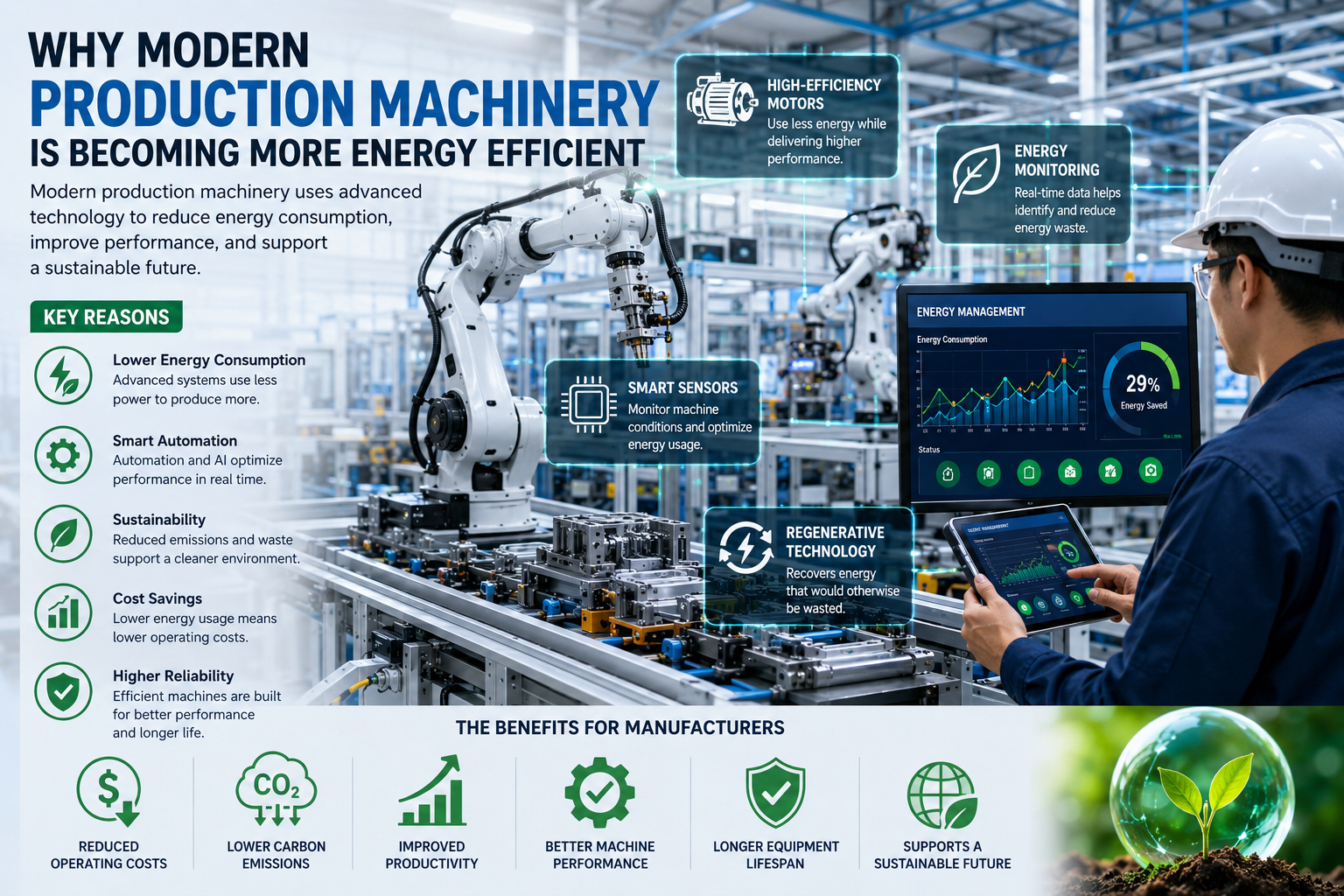
    Advances in motor technology, automation, artificial intelligence, predictive maintenance, smart sensors, regenerative systems, digital twins, and Industry 4.0 technologies have dramatically improved the efficiency of modern equipment.

    Unlike older machines that often operated at fixed settings and wasted significant amounts of energy, today’s production systems continuously monitor conditions, optimize performance, and minimize unnecessary consumption.

    The benefits extend beyond lower electricity bills. Energy-efficient machinery improves reliability, reduces maintenance requirements, supports environmental compliance, enhances productivity, and contributes to long-term business success.

    As technology continues to evolve, production equipment will become even smarter, more connected, and more sustainable. Companies that invest in these innovations today are positioning themselves for greater efficiency, stronger profitability, and a more resilient future in modern manufacturing.